
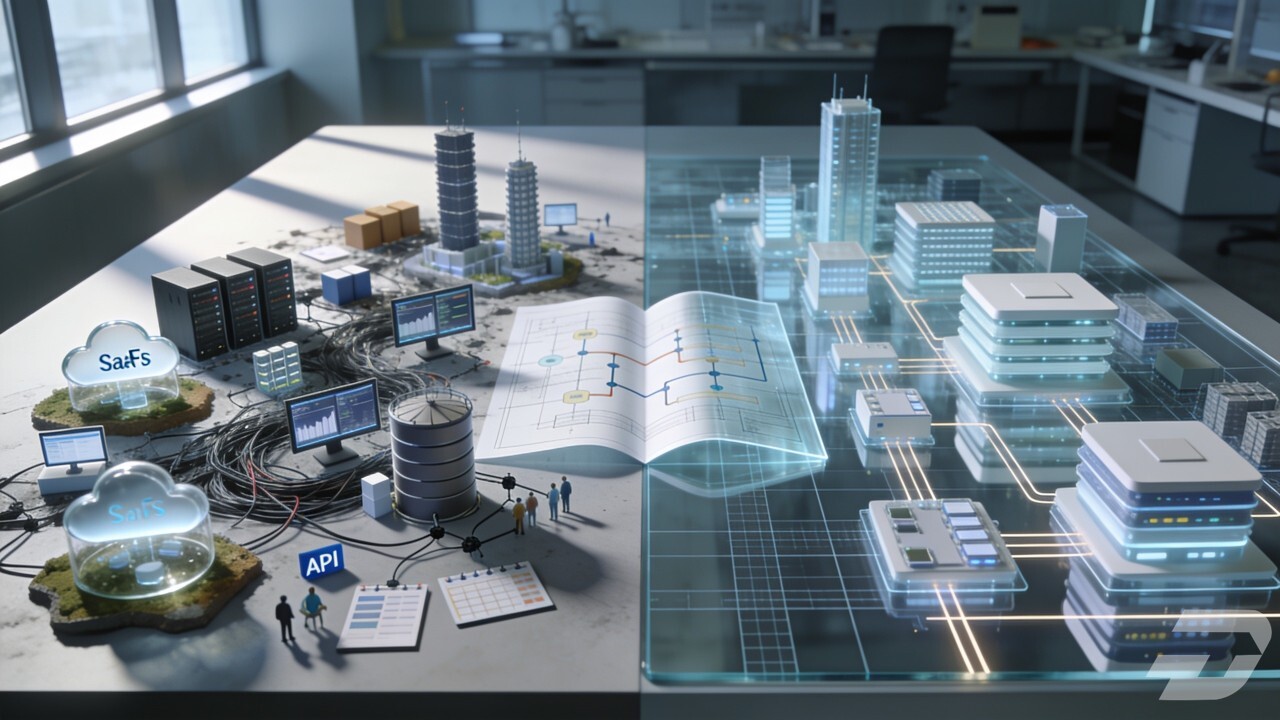
There was a remarkable phase in IT history when architecture suddenly didn’t seem quite so important anymore.
Of course, nobody officially said that. No board resolution declared: “We will henceforth abandon clean software architecture.” No IT strategy contained the sentence: “We will compensate for poor applications with more computing power.” And yet, that is exactly what happened in many organizations.
Servers got faster. Storage got cheaper. Cloud infrastructure became virtually limitless. Suddenly, hyperscalers could keep mediocre applications alive for an astonishingly long time. Even poorly structured PHP applications, historically grown database models, and hard-to-maintain process logic could somehow be kept running—if you just threw enough computing power at them.
What began in software architecture soon crept into enterprise architecture.
For years, core issues weren’t actually resolved; they were simply covered up. New SaaS solutions were introduced. Business units bought their own tools. Agile initiatives launched independently of one another. Individual processes were outsourced. Legacy systems were augmented with new layers rather than being replaced. Data wasn’t harmonized; it was just passed along via interfaces. And if something became slow, expensive, or hard to manage, it was rarely viewed as an architecture problem—it was simply accepted as “operational reality.”
The result is now glaringly obvious for many organizations: They have more technical solutions than ever before, but less actual architecture.
⚡ Performance Has Covered Up Architecture Problems
The technological progress of recent years has been massive. Cloud, SaaS, containers, APIs, low-code platforms, automation, and modern integration services have given companies incredible capabilities. Things that once took years can now be built in months or even weeks.
This was genuine progress. But it had a side effect.
Many organizations began to mistake technical high performance for architectural quality.
Just because a system scales doesn’t mean it is well-built.
Just because a SaaS solution can be deployed quickly doesn’t mean it fits into your enterprise architecture. Just because an integration is technically possible doesn’t make it business-logical. And just because a process is digitized doesn’t mean it is under control.
Performance didn’t prevent bad architectural decisions; it prolonged them.
In the past, technical limitations forced companies to be disciplined. You had to decide which systems were leading. You had to understand data models. You had to design interfaces deliberately. You had to carefully weigh which processes should be centrally managed and which could remain decentralized.
Today, you can just build, buy, or integrate another tool. This feels like freedom, but it is usually just deferred complexity.
🔌 SaaS Solved Many Problems—and Created New Ones
SaaS was a liberation. Business departments could move faster. IT organizations no longer had to custom-build every single feature. Standard software brought best practices, faster releases, and lower barriers to entry.
But a problem arises when SaaS is treated as a replacement for architecture, rather than a part of it.
- 👥 A CRM is introduced without defining which customer data is the single source of truth.
- 👤 An HR platform is bought without deciding how identities, roles, and permissions will be governed.
- 📈 A marketing tool is connected without establishing what data it is actually allowed to process.
- 📊 An analytics tool is set up without any clear expectations of data quality.
This is not how you build a modern IT landscape. This is how you build a growing collection of isolated software islands. Every single decision makes sense on its own. Every tool has a business case. But in total, you get an enterprise that can no longer explain itself:
- Which systems are leading?
- Which data is authoritative?
- Which processes are standard?
- Which platforms are strategic?
- Which capabilities do we need to own ourselves?
- What are the hidden costs of integration, shadow processes, and future migrations?
If you don’t answer these questions, you don’t have an architecture. You just have a pile of separate decisions.
🔄 Agile Initiatives Are Not a Target Picture
Agile methodologies have transformed businesses for the better. They broke down rigid project structures, brought business units closer to developers, and enabled rapid iteration.
But in many organizations, agility was deeply misunderstood.
Iterative work turned into directionless work. Product ownership turned into local optimization. Rapid deployment became a habit of bypassing foundational questions. Teams were measured on how many features they delivered, not on whether they contributed to the overall architecture.
An agile organization needs a clear target picture more than any other.
Agility does not mean every team designs its own architecture. It does not mean every department buys its own software. It does not mean enterprise architecture is replaced by backlogs, roadmaps, and local priorities.
When velocity lacks a shared architectural framework, speed simply becomes a complexity generator. It accelerates the accumulation of technical debt, undocumented data flows, and hidden dependencies that only surface when you try to migrate, consolidate, or comply with new regulations.
🏢 Enterprise Architecture is a Decision-Making Discipline
Many still associate “architecture” with abstract PowerPoint slides, heavy frameworks, and giant, unreadable diagrams. This is a misconception.
Enterprise architecture must not be a decorative staff exercise. It is a core decision-making discipline.
Clean architecture doesn’t just show how systems connect; it defines how a company fundamentally operates:
- Which core capabilities must we control ourselves?
- Where do we buy standard software, and where do we deliberately differentiate?
- Which platforms form the operating system of the organization?
- Which data must be usable enterprise-wide?
- How much freedom do we give business units before it hurts the whole?
These are not purely technical questions. These are management questions.
Every single one of these choices impacts cost, speed, risk, innovation, and stability. If management doesn’t answer them, they aren’t delegating architecture to IT. They are delegating it to coincidence, vendors, departmental budgets, and historical compromises.
🛒 “Make or Buy” is Not a Procurement Question
This issue becomes glaringly obvious during “make or buy” decisions.
Too often, this question is asked too late and framed too narrowly around licensing fees, implementation costs, or contract runtimes.
Make or buy is a strategic architectural decision.
A company must understand which capabilities it must own and which it can rent. Developing every piece of software in-house is absurd. But outsourcing every core capability to external vendors is dangerous.
If you outsource your data logic, process control, integration capabilities, and business differentiation entirely to third-party products, you lose long-term control. It may work beautifully at first. But with every additional vendor, custom adaptation, and proprietary interface, your strategic room to maneuver shrinks.
The true price of a wrong “make or buy” decision is rarely seen in the initial quote. It shows up years later in vendor lock-in, staggering complexity, and an absolute inability to change.
☁️ Cloud is Not an Architecture
Cloud computing is a massive advantage. It provides scalability, global availability, robust security, and faster innovation cycles. But cloud is not an architecture—cloud is an operating model and a toolkit.
- A poorly designed system doesn’t become good just because it runs in the cloud.
- An undefined data model doesn’t become clean just because it sits in a modern data lake.
- A chaotic process doesn’t become manageable just because you automate it with cloud services.
Many companies have confused cloud migration with architectural modernization. They shifted workloads without cleaning up process logic, and built platforms without clarifying responsibilities.
Cloud amplifies the quality of your decisions. A great architecture becomes exceptionally powerful in the cloud. A poor architecture just becomes faster, more expensive, and harder to untangle.
🌉 Integration is the Product, Not the Afterthought
Historically, integration was treated as a minor technical task at the end of a project. A system was bought, then connected. A process was digitized, then APIs were built.
This view is dead.
In a modern enterprise, integration is not a downstream connection. Integration is a core component of the enterprise architecture itself.
Almost every critical business process today spans multiple systems, data sources, and organizational units. Your customer journeys, supply chains, regulatory reporting, and AI applications only run smoothly if your underlying integration architecture is solid.
If you view integration as merely a technical task, you miss the vital question: How is our company supposed to function as a unified whole?
💸 The Hidden Cost of Missing Architecture
The dangerous thing about architectural decay is that it is highly tolerable for a long time.
One extra tool doesn’t hurt. A quick, manual workaround is pragmatic. A legacy system can keep running as long as it’s stable.
But eventually, you hit a wall.
Suddenly, a simple change takes months. New compliance rules clash with undocumented data flows. Promising AI initiatives fail because the underlying data quality is terrible. Cost-cutting measures stall because no one understands the end-to-end costs of the IT landscape.
When you reach this point, the diagnosis is clear: The organization doesn’t suffer from a lack of technology. It suffers from a lack of architecture. More specifically, it has failed to make binding, foundational decisions.
🛑 Structure is the Prerequisite for Speed
Emphasizing architecture again is not a call to return to old-school, bureaucratic IT committees. It is not about blocking local innovation or slow-walking business initiatives.
On the contrary: Good architecture creates speed because it creates clarity.
When an organization establishes which platforms are strategic, teams don’t have to debate foundational questions for every new project. When data ownership is clear, new applications can be developed instantly. When integration principles are non-negotiable, you stop building fragile custom workarounds.
Unternehmensarchitektur is not the enemy of velocity. It is the very reason speed doesn’t devolve into chaos.
🎯 The Path Forward: Building a Target Picture
Your organization doesn’t need another generic “transformation program” with a fancy new name. It needs a resilient, strategic target picture of your IT and process landscape.
This target picture doesn’t need to specify every technical detail for the next five years. But it must definitively answer the essentials:
- Which platforms form our core digital foundation?
- Which systems are strategically set, and which legacy applications are actively being retired?
- What integration and data architectures are strictly binding?
- Which capabilities do we build ourselves, and which do we buy?
- Which architectural decisions can business units make independently, and which must be decided centrally?
Without these answers, every digital initiative remains isolated. You will have plenty of local progress, but zero enterprise-wide impact. Many tools, but no control. Many projects, but no direction.
At its core, architecture is not a technical drawing of a system landscape. It is the sum of fundamental decisions that dictate how your business operates, scales, complies, and innovates.
Because in business, if you don’t choose your architecture, you still get one. You just get one designed by coincidence, vendor interests, and accumulated technical debt.
It’s time to stop choosing chance, and start designing your organization’s future.
image sources
- 1784049058395: Generated using Nano-Banana

Join the discussion