
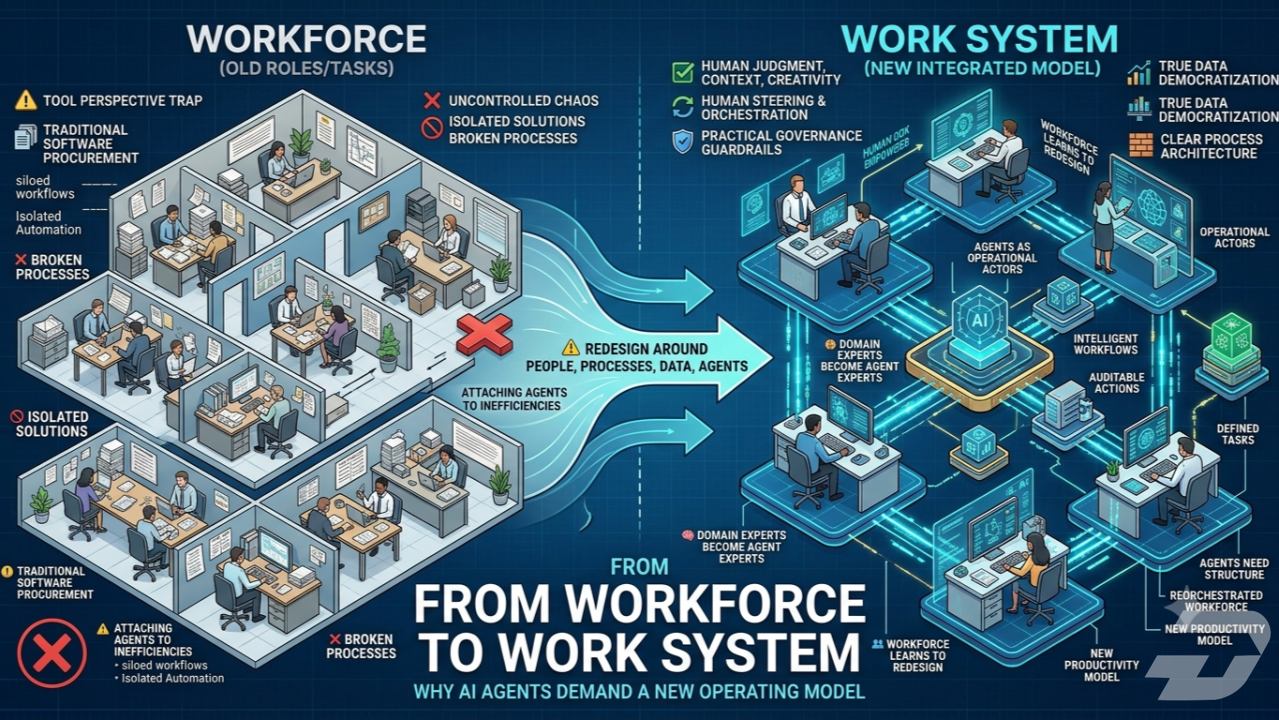
AI adoption is often discussed as if the central question were how quickly a workforce can start using new tools.
That is the wrong starting point.
The real question is not whether employees can use AI. The real question is whether the organization understands its own work well enough to redesign it around people, processes, data, and intelligent agents.
This is a much deeper transformation than introducing copilots, chatbots, or automation assistants. AI agents do not simply make existing work faster. Used properly, they change how work is structured, assigned, executed, reviewed, and improved.
That makes workforce transformation one of the most important management challenges of the next decade.
Not because people need to be replaced by technology. But because organizations need to become capable of separating the work that should be automated from the work that must remain human.
🚫 The Mistake Starts With the Tool Perspective
Many companies approach AI agents with the same logic they used for traditional software procurement.
They look for a platform. They define a few use cases. They run a proof of concept. They measure some local efficiency gain. Then they declare progress.
This may create activity. It does not necessarily create transformation.
Because AI agents do not unlock their full value when they are placed on top of broken processes. They unlock value when work itself is redesigned.
If a company simply attaches agents to existing inefficiencies, it does not solve the underlying problem. It accelerates the disorder. Old handovers become faster handovers. Unclear responsibilities become faster confusion. Poor data produces faster wrong answers. Fragmented workflows become automated fragmentation.
This is how the next generation of isolated solutions is created.
One department builds an agent for its local workflow. Another team builds a workaround for its exception logic. A third unit automates a task without understanding the dependencies before and after it.
From the outside, this looks innovative.
In reality, it often reproduces the same silo logic companies have been struggling with for years.
An AI agent built inside a silo does not automatically break the silo. More often, it makes the silo more efficient at staying a silo.
🔍 Processes Must Be Understood Before They Can Be Automated
Before companies can use agents effectively, they must understand how work actually happens.
Not how it is described in an organizational chart. Not how it appears in a process handbook. Not how management assumes it works from a dashboard.
But how it really works.
Which information is needed? Who makes which decision? Where do delays occur? Which steps create value? Which steps only exist because systems do not talk to each other? Which manual activities compensate for missing data, unclear ownership, poor integration, or historical workarounds?
Without this understanding, agent implementation remains superficial.
This is not only a challenge for operations teams. It is especially a challenge for management.
A company cannot intelligently automate processes if its leadership does not understand the business processes deeply enough. Managers do not need to perform every operational task themselves. But they must understand where value is created, where complexity is hidden, where risk enters the process, and which parts of the work are actually suitable for automation.
If management only sees KPIs but not the process reality behind them, it will make poor automation decisions.
It will automate visible effort instead of structural waste. It will optimize local steps instead of end-to-end outcomes. It will reward impressive demos instead of sustainable operating model improvements.
AI agents force management to move closer to the real mechanics of the business.
⚙️ Agent Readiness Is Process Readiness
In a previous article, I argued that AI must be understood as an operating system of the organization, not as another tool in the IT portfolio: AI as an Operating System: Why AI Readiness is a Management Mandate.
The same logic applies to agents.
Agents are not isolated productivity widgets. They are operational actors inside the future work system of the company. That means they need structure.
They need defined tasks. They need reliable data access. They need clear permissions. They need escalation paths. They need quality criteria. They need auditability. They need human ownership.
Without that structure, companies do not build agentic organizations. They build agentic chaos.
This is why process architecture becomes critical.
An organization must define which processes are agent-ready. Which steps can be automated? Which steps must remain human? Where is human review required? Where can an agent act independently? Where may it only prepare a recommendation? Where do legal, regulatory, ethical, or customer-impact constraints apply?
These are not technical configuration questions.
They are operating model questions.
👥 The Workforce Must Learn to Redesign Its Own Work
A dangerous simplification in the AI debate is the constant focus on replacement.
Which jobs disappear? Which roles become unnecessary? How many tasks can be automated away?
Of course, AI will automate certain activities. Of course, roles will change. Some work that is performed manually today will no longer exist in the same form tomorrow.
But the more important question is different:
How do we enable employees to understand which parts of their work can be automated so they can focus on the parts that truly require human judgment?
That is the core of workforce transformation.
Employees must learn to break their own work into components. Which parts are repetitive? Which parts are rules-based? Which parts require searching, comparing, summarizing, checking, documenting, or monitoring? Those are often strong candidates for agent support.
But other parts are different.
Context matters. Judgment matters. Relationship matters. Responsibility matters. Prioritization matters. Creativity matters. Ethical assessment matters. Customer understanding matters. Domain intuition matters.
These are not the parts companies should blindly automate away.
They are the parts employees should be freed up to do better.
The goal is not to remove the human from work. The goal is to remove unnecessary execution load so humans can contribute where their expertise creates the highest value.
🔄 From Executing Tasks to Steering Workflows
Many roles in today’s organizations are still execution-heavy.
People search for information, transfer data, reconcile lists, prepare reports, summarize meetings, chase approvals, document decisions, check statuses, and coordinate handovers.
With AI agents, this balance shifts.
The human role moves from executing every step to steering intelligent workflows.
The employee defines the objective. The agent prepares the work. The employee provides context. The agent gathers and structures information. The employee reviews risk. The agent performs repetitive checks. The employee decides on exceptions. The agent documents and monitors the outcome.
This is a different productivity model.
Performance is no longer measured only by how many tasks a person completes manually. It is increasingly measured by how effectively someone can produce high-quality outcomes through a combination of expertise, process understanding, data, systems, and agents.
That changes role descriptions. It changes training. It changes leadership. It changes target systems. It changes how organizations think about productivity.
🧠 From Hands-On Experts to Process and Agent Experts
One of the biggest opportunities is hidden inside the existing workforce.
Every company has people who understand how the business really works. They know the exceptions. They know the informal workarounds. They know which process steps are necessary and which ones only exist because the system landscape is broken. They know what customers actually ask for. They know what goes wrong before it appears in management reporting.
These people are essential for agent transformation.
The future does not only require more AI engineers. It also requires process and agent experts who come from the business itself.
Hands-on domain experts can be developed into people who understand, optimize, and teach processes to AI agents.
Their role changes.
They no longer need to perform every task manually from start to finish. Instead, they help define how the task should be decomposed, which steps an agent can perform, which decisions need human review, what good output looks like, which exceptions matter, and where risk must be controlled.
This is a fundamentally different use of expertise.
In traditional automation, companies often tried to replace human knowledge with rigid process logic. With AI agents, domain knowledge can be translated into more flexible, adaptive workflows.
But only if the people who understand the work are actively involved.
Companies should therefore stop asking only: Which tasks can we automate?
They should also ask: Which people understand our work deeply enough to teach agents how to support it properly?
🧱 Architecture Still Matters
This connects directly to a broader architectural problem.
In another article, I argued that speed without structure becomes a trap: The Return of Architecture: Why Speed Without Structure is a Trap.
Agent transformation makes this even more visible.
If there is no clear process architecture, agents will follow local assumptions. If there is no integration architecture, agents will create new workarounds. If there is no data architecture, agents will work with incomplete context. If there is no ownership model, no one will know who is responsible for the result.
AI agents do not remove the need for architecture. They increase it.
Because once agents begin to act across systems, processes, and business units, structural weaknesses become operational risks.
A poorly understood process may be tolerable when handled manually by experienced people. It becomes dangerous when automated at scale.
🛡️ Governance Must Create Confidence, Not Fear
There is also a human adoption problem.
Employees will not openly redesign their work if they fear that doing so will make them replaceable. They will not use agents confidently if they do not understand what is allowed. They will not experiment productively if every AI use case feels like a compliance risk.
In a separate article on AI governance, I argued that governance must work as guardrails, not handbrakes. Employees need practical clarity, not paralyzing uncertainty.
This matters directly for agent transformation.
If people are expected to identify automation potential in their own work, they must feel protected. They need to know that the goal is not to punish transparency. They need to understand which tools are approved, which data can be used, when human review is required, and who owns the final decision.
Without this clarity, organizations will not get real adoption.
They will get polite participation, hidden resistance, or shadow AI.
Good governance does not slow down workforce transformation. It makes it safe enough to scale.
📊 Data Democratization Remains a Foundation
The same applies to data.
In my article on data democratization, I described why modern dashboards and SaaS systems do not automatically create a truly data-capable organization: From Dashboards to Leadership: True Data Democratization.
For agents, this is a prerequisite.
An agent can only act intelligently if it has access to the right data, in the right quality, under the right permissions, with the right context.
If data remains trapped in silos, agents work with tunnel vision. If access rules are unclear, agents create risk. If metadata is missing, agents misunderstand meaning. If data ownership is weak, accountability disappears.
This does not need to be repeated in full here. But it must be understood: agent transformation without data democratization remains local automation.
It does not become enterprise transformation.
🎯 The New Role of Management
Management cannot delegate this transformation to IT, HR, or individual innovation teams.
IT can provide the platforms. HR can support capability building. Compliance can define guardrails. Data teams can support architecture and access models. Business units can identify use cases.
But leadership must decide how the company will work in the future.
Which processes should be redesigned? Which roles will change? Which capabilities must be built? Which decisions can be prepared or executed by agents? Which parts of work must remain human? Which operating model do we want to build?
These are not implementation details.
They are strategic management decisions.
A company that treats AI agents as tools will create tool-level results. A company that treats agents as part of a new operating model can redesign how work flows through the organization.
🚀 Agent Transformation Is Not a Shortcut
The biggest temptation is to see agents as a shortcut.
A shortcut around unclear processes. A shortcut around missing data governance. A shortcut around poor integration. A shortcut around workforce capability building. A shortcut around management work.
But agents are not a shortcut around organizational maturity.
They amplify the maturity that exists.
In a clear process landscape, they create speed. In a fragmented process landscape, they accelerate fragmentation. In a data-capable organization, they create intelligence. In a siloed organization, they create narrow automation. In a well-governed environment, they create confidence. In an unclear environment, they create risk.
The decisive question is therefore not: Which agent platform should we buy?
The decisive question is: Are we building an organization that is ready to work with agents?
🎯 Conclusion: The Future Workforce Is Not Replaced. It Is Reorchestrated.
AI agents will not simply replace employees. They will force companies to redefine how work is divided between humans, systems, data, and intelligent automation.
That is the real transformation.
The future workforce will not be valuable because every person performs every task manually. It will be valuable because people understand processes deeply, know where human judgment matters, and can orchestrate agents to execute, prepare, monitor, and improve the rest.
This requires more than software procurement.
It requires process understanding up to the management level. It requires employees who can rethink their own work. It requires hands-on experts who become process and agent experts. It requires clear architecture, practical governance, and usable data foundations. And above all, it requires leadership that understands AI agents not as a tool rollout, but as a redesign of the operating model.
The companies that succeed will not be the ones that buy the most impressive AI agents.
They will be the ones that understand their work deeply enough to reorchestrate it.
image sources
- 1784657686099: Generated using ChatGPT

Join the discussion