
Currently, almost every company wants to show that it is not losing touch when it comes to artificial intelligence. Pilot projects are launched, tools are tested, strategies are announced, and presentations are given an AI spin. The impulse is understandable—no one wants to be late for the next big technological leap.
But that is precisely where the danger lies.
Many companies treat AI like a technical extension of their existing digitization. Just another tool. Another platform. Another assistant. Another project in the IT portfolio.
But AI is not simply the next software category.
Properly understood, AI becomes the operating system of the organization. Not in the technical sense of a classic IT system, but as a new fundamental layer through which knowledge is made available, decisions are prepared, processes are controlled, and value creation is organized.
This doesn’t just change individual applications. It changes how a company works.
Therefore, AI is not purely a technology issue. AI is a management issue.
🚨 The AI Hype Often Starts at the Wrong End
In many organizations, the discussion today begins with the question of which AI tools should be introduced. People talk about chatbots, assistants, automation, productivity gains, and efficiency. This sounds modern, but it is often not sustainable.
- The superficial question: Which AI solution can we buy?
- The real question: Is our company even AI-ready?
This real question is much more uncomfortable. It doesn’t immediately lead to a beautiful demo or an impressive dashboard. Instead, it forces companies to look at their own substance: data quality, system landscapes, responsibilities, processes, governance, compliance, and leadership understanding.
And that is exactly where it gets difficult.
Over years, many companies have built fragmented data landscapes. Data resides in business departments, legacy systems, Excel structures, shadow IT, CRM systems, data warehouses, data lakes, and various specialized solutions. Often, there is a lack of a common understanding of what data exists, who owns it, what its quality is, and how it may be used.
No sustainable AI strategy can be built on this foundation—and certainly no organizational operating system.
📊 No AI Without Data Order
The first step on the path to AI is not the language model. The first step is data order.
A company must know what data is available, where it is located, how it is generated, how it is classified, what rights apply, what dependencies exist, and what quality it has. Without data inventory, data classification, and clear data ownership, AI remains an experiment on shaky ground.
It is not enough to build a few interfaces, migrate a system, or push existing data into a new technical environment. This is often just digital cosmetics. A company does not become AI-ready because data is stored in a new location. It becomes AI-ready when data is understood, structured, manageable, and usable in compliance with regulations.
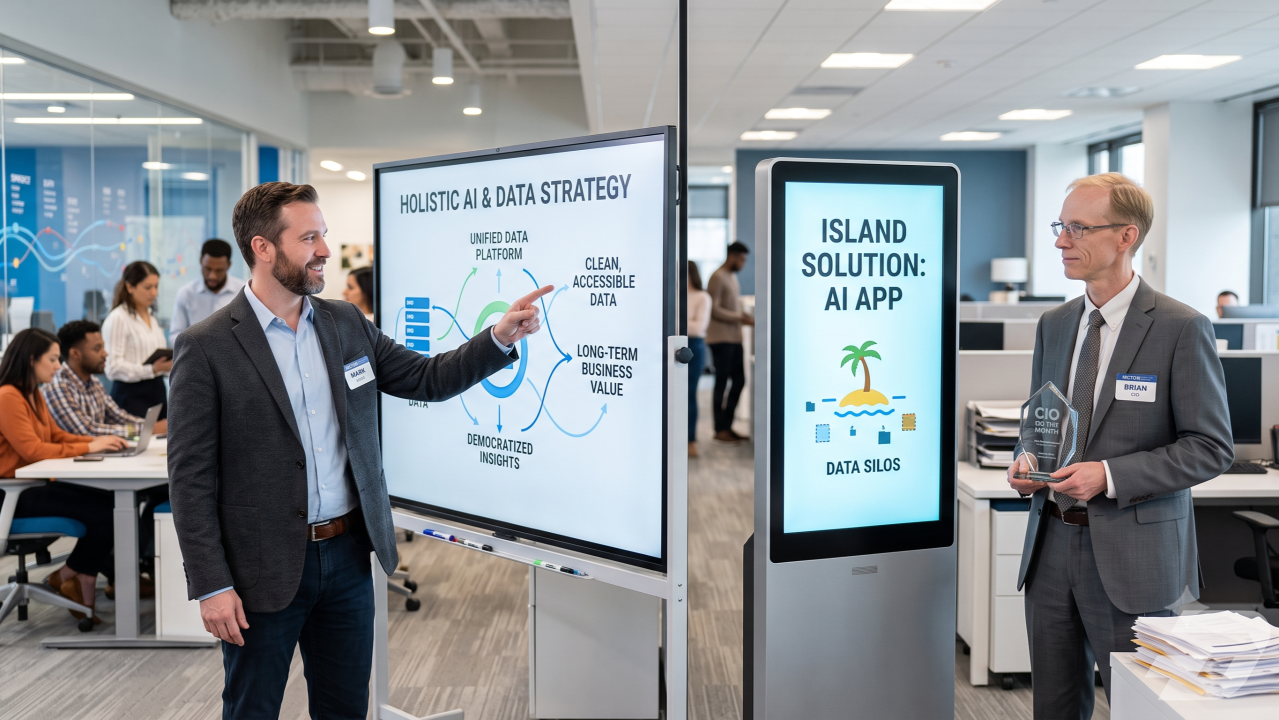
Breaking Down the Silos
Above all, AI must not be built on top of data silos. If data remains locked in departments, systems, or historical custom solutions, an intelligent organization will not emerge. Instead, you only get individual applications that appear intelligent. They access limited slices of reality and reproduce the company’s existing boundaries in a new form.
This is the core mistake of many current AI initiatives: they modernize the surface, but not the underlying business logic.
⚙️ Holistic Strategy Instead of Tool Procurement
Many companies today proceed in the wrong order. They start with AI applications, then look for the right data, and subsequently realize that the data foundation is insufficient. The result is isolated solutions (silos) that work in a presentation but fail at an industrial scale. They generate short-term attention, but no structural change.
The correct, sustainable sequence is different:
- Data Transparency ➔
- Data Strategy ➔
- Data Policy ➔
- Holistic AI Strategy ➔
- Scaled AI Applications
This sequence is not particularly spectacular, but it is necessary.
- AI without a data strategy is blind actionism.
- A data strategy without governance remains theory.
- Governance without management commitment remains paper.
- AI without a holistic corporate strategy remains a collection of isolated projects.
If AI is to become the operating system of the organization, it must not be introduced in silos. It must be thought of horizontally across business units, processes, data spaces, and decision-making levels. It is a fundamental capability, not an add-on.
🛡️ Data Policy is Not a Side Issue
A central component of this development is a real corporate data policy. Data must no longer remain locked in departments, systems, or personal spheres of power. If AI is to be effective, data must be controlled but accessible.
This does not mean everyone can see everything. It means data must be democratized with clear roles, rights, responsibilities, and rules:
- Empowerment: Business departments must be enabled to use data meaningfully.
- Security: Data protection, information security, compliance, and quality must be rigorously secured.
Data democratization is therefore not a soft cultural topic. It is a hard management mandate. Without it, AI remains limited to a few specialists and isolated initiatives. With it, AI can have a broad, transformative impact across the entire organization.
🔄 AI Changes How the Company Works
The real effect of AI is not that individual tasks are completed faster. That is only the first visible layer. The deeper effect is fundamental:
- AI changes how information is found.
- AI changes how decisions are prepared.
- AI changes how processes are managed.
- AI changes how departments collaborate.
- AI changes how management gains transparency.
- AI changes how companies learn.
Thus, AI directly intervenes in the organization’s operating model. Viewing it merely as a productivity tool is too short-sighted. AI can become the connecting layer that brings together data, processes, knowledge, and decisions. But for exactly that reason, it must be designed as strategic infrastructure for the future of work, not as a showroom project.
💡 The Leadership Question Behind the Technology
At this point, AI becomes a management question. An organization does not become AI-ready by buying modern software. It becomes AI-ready when management understands the fundamental prerequisites that must be established.
Many executives already consider their organization modern, pointing to cloud projects, agile methods, digital channels, and automation initiatives. This is not wrong, but it is not enough. The decisive question is not whether a solution looks modern—the question is whether it fits.
Companies do not need the most spectacular solution; they need the right solution. A solution that fits their data situation, process maturity, organization, business model, and regulatory reality. Real transformation does not happen on the surface; it happens where AI is deeply integrated into processes, steering, decision-making, and value creation. That requires substance, and substance is built through management work, not hype.
🎓 The CIO as an Enterprise Architect
The CIO plays a central role in this development, but the responsibility does not lie solely with IT. Today, a CIO is no longer expected just to operate stable IT systems or buy new tools. The CIO must connect technology, data, processes, organization, compliance, and business goals—effectively becoming an enterprise architect.
1. The IT Administrator (Operative)
- Focuses on procuring tools and platforms.
- Launches isolated pilot projects for quick wins.
- Modernizes the surface level.
2. The Enterprise Architect (Strategic)
- Focuses on the organization and its structures.
- Designs data, processes, and decision-making paths first.
- Aligns underlying corporate architecture for sustainability.
Still, this responsibility must not be passed off solely to the CIO. AI readiness is not an IT delivery service for the business. It is a shared leadership task for the executive board, management, business units, IT, compliance, data protection, and operations.
🎯 Conclusion: Substance Over Showmanship
The actual task is not to simply introduce AI somehow. The task is to make the company AI-ready.
AI readiness means that data is known, structured, available, qualitatively reliable, and usable in compliance with rules. It means that business departments and management understand how data-driven decisions are made.
- If you treat AI only as a tool, you will get tool-level results.
- If you understand AI as the operating system of the organization, you can transform your company.
The current AI hype tempts many companies to prioritize the visible parts of the transformation. Yet, true AI readiness is built in the data foundation, in governance, in the organization, and in leadership understanding.
Companies that understand this will not just deploy AI—they will use it to newly empower their organization with better data, better decisions, fewer silos, and a systematic way of leveraging knowledge. Those who do not will merely present modern solutions without truly changing their organization.
image sources
- 1784048073309: Generated using Nano-Banana

Join the discussion