Many companies today talk about data as if they’ve cracked the code. They point to their dashboards, data lakes, BI teams, modern SaaS solutions, platform strategies, and, of course, their latest AI initiatives. On the surface, it looks like progress.
In reality, the picture is very different.
Most organizations do not possess a democratized data landscape. Instead, they own a highly sophisticated, expensive collection of modern data silos.
Even the most advanced software applications are, by design, closed systems. They process data, store data, and display data beautifully within their own user interfaces. They offer APIs, but they do not automatically share data the way your business actually needs it.
- 👥 CRM systems know everything about your customers.
- ⚙️ Core processing platforms know everything about your operations.
- 💼 ERP systems know everything about your contracts, invoices, and purchase orders.
- 🎫 Service platforms know everything about tickets, issues, and communication.
- 🎯 Marketing tools know everything about campaigns and behavior.
Yet, the organization as a whole often knows less than the sum of its parts.
🚫 Modern Software Does Not Equal Modern Data Capability
It is a common misconception that buying modern SaaS solutions automatically turns you into a data-driven organization. SaaS products are optimized for specific transactional tasks—solving a single process, function, or customer experience.
SaaS capability is not the same as data capability.
The deeper a system sits within your operational core, the more valuable its data becomes—and the harder it is to access. This isn’t just a technical barrier; it’s a web of access permissions, complex data models, legacy logic, proprietary APIs, regulatory constraints, and missing organizational ownership.
In highly transactional, process-heavy industries—such as energy, telecom, finance, or insurance—this pain point is glaringly obvious. Core systems in these sectors aren’t just databases; they are the business’s actual operating engines.
To leverage this data, you can’t just query a simple table; you are tapping directly into the nervous system of the enterprise.
That is why introducing another BI tool or copying data into yet another data lake won’t solve the problem. Data democratization doesn’t start with visualization—it starts with enterprise architecture.
⚖️ Democratization is Not Anarchy (Everyone Doesn’t See Everything)
The term “data democratization” is frequently misunderstood. It conjures up images of radical openness—data for everyone, self-service with zero boundaries.
That would be a governance nightmare.
True democratization does not mean scattering raw data across the company, nor does it mean watering down data privacy, security, or regulatory compliance. The exact opposite is true.
Real data democratization means data is used in a controlled, traceable, purpose-bound, and revocable manner.
In most companies, data access falls into one of two extremes—both of which are broken:
- 🧱 The Bureaucratic Wall: Access is so heavily restricted that every request must go through IT tickets, lengthy approvals, and weeks of waiting. This completely chokes business value.
- 🤠 The Wild West: Employees bypass restrictions by relying on ad-hoc exports, local Excel files, shadow IT, and personal networks. This completely destroys data governance.
Forward-thinking organizations must build a third way: Data must become orderable. Not through chaos, and not through red tape, but as a standardized, transparent, and business-managed enterprise process.
📦 Data Must Become “Orderable”
An employee, a department, or a new software application should never have to source data through backchannels or informal networks. It should be immediately clear what data exists, what it can be used for, who owns it, how sensitive it is, and under what conditions it can be accessed.
To achieve this, you need a highly functional Data Catalog—not as a passive directory, but as a living, breathing operational tool.
Every data asset must be cataloged with clear metadata:
- 📖 Business Definitions: What does this data actually mean?
- 🌿 Technical Lineage: Where did this data come from?
- 🔒 Classification & Sensitivity: What security level applies?
- 👤 Ownership & Terms of Use: Who is responsible, and what are the regulatory limits or retention rules?
This is where metadata becomes business-critical. Standards like ISO/IEC 11179 exist for a reason: they ensure data is described in a way that makes it understandable, comparable, and governable across the entire organization. Without a standardized metadata logic, scalable data democratization is impossible.
🏢 Governance Must Mirror the Business, Not the Software
The market has recognized this challenge. Modern platforms offer built-in governance layers—from Microsoft Fabric (OneLake) and Databricks (Unity Catalog) to Snowflake (Horizon Catalog) and enterprise tools like Collibra.
While these platforms are incredibly valuable, software alone does not solve the governance problem.
Governance is not just a software feature; it is a reflection of your organizational structure. And every business is unique:
- 🌍 A multi-entity global conglomerate requires a vastly different governance model than a mid-sized regional player.
- ⚡ An energy utility faces entirely different regulatory hurdles than a retail business.
Therefore, your company must never force itself into the rigid governance template of a software tool. Instead, the platform must adapt to the governance logic of your business.
Your systems must be flexible enough to handle the nuances of real-world business operations. Sometimes, a simple manager sign-off is enough. Other times, you need dual-control (four-eyes, six-eyes, or eight-eyes principles), involving legal, compliance, data protection, or information security. Sometimes, data must be anonymized, pseudonymized, or restricted by time bounds. These aren’t edge cases—they are the standard reality of doing business.
🚦 Data Access is Not an IT Favor
One of the most damaging mistakes a company can make is treating data access as an “IT issue.”
Yes, IT must build and maintain the technical infrastructure, secure the integrations, and ensure system uptime. But the decision of who gets to use what data for which business purpose is not an IT decision.
- 🤝 Business Owners must take accountability for the data they generate.
- 📈 Business Teams must clearly articulate why they need the data.
- 🛡️ Compliance & Data Protection must define the guardrails.
- 💻 IT must build the pipeline to enable it.
IT should never be forced to play the role of referee for business data questions. When data access requests disappear into endless IT ticket queues, every stakeholder optimizes for risk avoidance rather than business value creation.
Governance should never exist to prevent value creation. Its job is to make value creation safe and scalable.
🤖 Democratization is Not Just for Humans
Historically, we’ve discussed data democratization as a way for analysts to build reports in Power BI, Tableau, or Excel.
In the age of AI, that definition is dangerously narrow.
True democratization must extend to software products, automation workflows, and AI agents. When a new AI application is introduced, you shouldn’t have to build a custom integration pipeline from scratch. The system should instantly know which data products exist, which APIs are available, and what governance policies apply automatically.
AI models are only as good as the data context they are allowed to access. If an AI agent is fed incomplete, poorly described, or legally unauthorized data, you don’t just get bad results—you create massive operational and regulatory risks.
An AI working with customer data needs more than raw system access. It needs purpose-bound, compliant, high-quality, and structurally sound data with real-time updates and strict retention logic.
Without data democratization, AI is either completely blind or incredibly dangerous.
🧳 Privacy Must Travel with the Dataset
A fatal flaw in many data strategies is treating privacy as an afterthought or a final compliance checklist.
If a dataset contains personally identifiable information (PII), that classification shouldn’t just live in a PDF policy document on your intranet. It must be embedded into the data asset itself.
Data privacy, country of origin, legal basis, retention periods, and transfer restrictions must travel alongside the data as metadata.
Data is highly dynamic. It is transformed, aggregated, combined, and fed into different models and applications. If the governance and privacy metadata are lost during this journey, the company instantly loses control and faces severe regulatory exposure.
🎯 The Ultimate Goal: A Data Democratization Platform
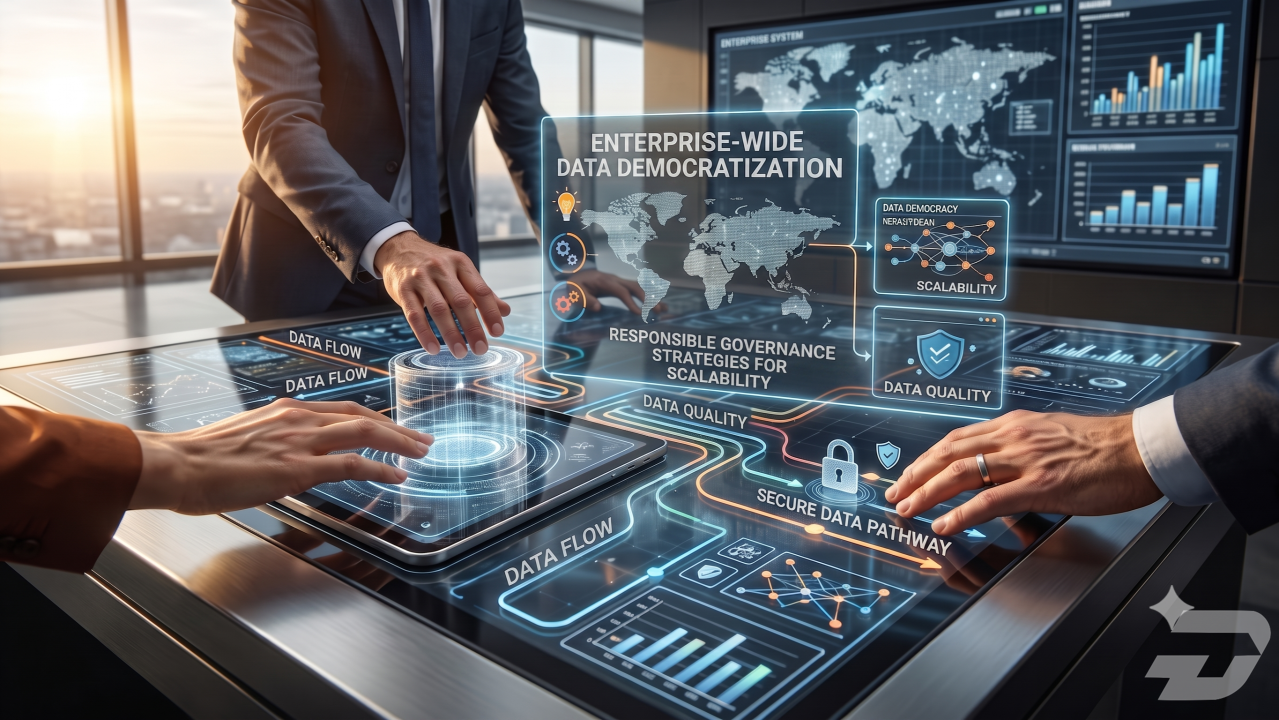
To scale, enterprise-level companies require a unified platform designed not just to collect data, but to make it safely usable. This platform must:
- 🔌 Connect seamlessly to SaaS systems, legacy engines, data lakes, and APIs.
- 🏷️ Catalog and define data assets in clear business terms.
- 🛡️ Embed metadata for privacy, ownership, quality, and lifecycle rules.
- 🔍 Make data discoverable without exposing sensitive details prematurely.
- 🛒 Provide an intuitive interface to request and “order” data.
- ⚡ Automate approvals based on your specific business rules.
- 📦 Deliver secure data to humans, software products, and AI agents alike.
Only then does a chaotic, fragmented IT landscape transform into a controlled, high-velocity data ecosystem.
📝 A Data Strategy is Not a Slide Deck
Almost every company has a “Data Strategy” on paper. It usually features buzzwords like data-driven decisions, self-service BI, and AI-readiness.
But a data strategy is only real when:
- An employee can find, understand, request, and use data without launching a six-month IT project.
- A new software product can pull data without breaking your enterprise architecture.
- PII remains strictly protected and governed even after being transformed, analyzed, and shared.
- Business leaders take ownership of their data rather than reflexively blocking access out of fear.
- Governance becomes an accelerator of speed, not a handbrake.
Data democratization is not a tech luxury. It is a core pillar of modern business leadership.
In the near future, companies will not compete on the software they buy. They will compete on how effectively they organize and activate the knowledge hidden within their data.
Those who keep their data in silos will severely limit their own organizational intelligence. Those who democratize their data safely and systematically are building the operating system for the next generation of business.
image sources
- 1784047889765: Generated with ChatGPT

Join the discussion